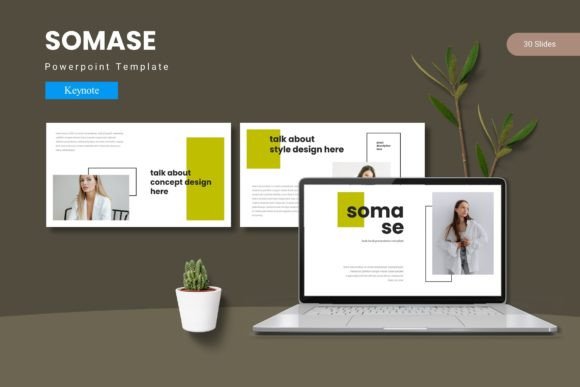
Somase - Keynote Template: Building Cohesive Presentations That Hold Audience Attention
Every presentation begins with a blank slide. That white rectangle can feel like an invitation or an obstacle depending on the tools you bring to the process. The gap between a scattered set of slides and a seamless visual narrative often comes down to the underlying structure of the template you choose. When you work with a design system built for coherence, each slide flows naturally into the next, and your audience stays focused on your message rather than noticing jarring transitions between layouts. The Somase - Keynote Template addresses this challenge directly by providing a complete ecosystem of 150 slides organized across five premade color schemes, giving you a flexible foundation that adapts to a wide range of presentation contexts without forcing you to start from scratch.
Why Slide Cohesion Matters More Than Individual Slide Design
A common mistake in presentation building is treating each slide as an independent design project. You might spend hours perfecting the look of your title slide, only to realize that your content slides use different font weights, inconsistent icon styles, or color accents that shift unpredictably from one section to the next. Audiences rarely notice a single beautiful slide in isolation. What they do notice is the cumulative effect of visual harmony or the subtle discomfort of inconsistency. The Somase - Keynote Template eliminates this problem by anchoring every layout to a shared visual language. With 30 slides built for each of the five color variations, you can move through an entire presentation knowing that your audience sees a unified brand experience rather than a patchwork of individual designs.
This consistency becomes especially valuable when multiple team members contribute to the same deck. A sales team preparing a quarterly review, a research group compiling findings, or a creative agency presenting campaign concepts all benefit from a template that enforces visual standards without restricting content. The master slides architecture means that when you adjust a color or font at the template level, every slide updates automatically. That kind of efficiency saves hours of manual adjustment and reduces the risk of errors slipping through before a high-stakes presentation.
Understanding the 150-Slide Architecture and Its Practical Applications
A template with 150 slides might sound excessive until you consider the variety of content types a single presentation often requires. You need section breaks to signal transitions, data-driven infographics to communicate research findings, portfolio pages to showcase work, and gallery layouts to display visual examples. The Somase - Keynote Template distributes these slide types across five color schemes, giving you 30 slides per scheme. That means you are not forced to reuse the same three or four layouts repeatedly throughout a long deck. Instead, you can select the most appropriate layout for each piece of content, keeping your presentation visually engaging from start to finish.
The section break slides deserve particular attention because they serve a function that many presenters overlook. A well-designed section break does more than separate chapters. It gives your audience a mental pause, a moment to reset before absorbing the next block of information. Without these transitional slides, presentations can feel like a continuous stream of data that blends together and loses impact. The handcrafted infographic elements included in this template add another layer of utility. Instead of pasting raw charts or tables that require explanation, you can use the pre-built infographic layouts to turn complex data into visual stories that your audience can grasp at a glance.
How the Five Color Variations Change Your Workflow
One of the most practical features of this template is the inclusion of five complete color schemes in a single folder. Most presentation templates force you to choose a color variant at the point of purchase, locking you into that decision before you have even begun building your content. The Somase - Keynote Template gives you all five options upfront, which changes how you approach color selection. You can experiment with different schemes against your actual content, testing how a light background handles dense data versus a dark background, or how different accent colors affect the readability of your infographics. This flexibility is especially useful when you are preparing presentations for different clients, departments, or brand guidelines. You can maintain the same structural integrity of your slides while shifting the color identity to match each context.
The color variations are not superficial overlays. Each scheme has been constructed to maintain proper contrast ratios, ensure accessibility, and preserve the legibility of text and illustrations across every slide type. When you switch between schemes, the relationship between background, headline, body text, and accent elements remains balanced. This attention to detail matters because a template that looks good in one color but breaks in another is not truly flexible. It is simply a locked design with a different paint job. The Somase - Keynote Template treats color as an integral part of the design system, not an afterthought.
Working with Pixel-Perfect Illustrations and Resizable Graphics
Another factor that separates a usable template from a frustrating one is how well the included graphics behave when you resize or reposition them. Many templates use raster images that pixelate or become distorted when scaled beyond their original dimensions. The Somase - Keynote Template relies on pixel-perfect illustrations that remain sharp whether you use them at their default size or enlarge them to fill a full slide. All graphic elements are resizable and editable, which means you can adjust colors, scale, and positioning without losing quality. This is particularly valuable when you need to create custom diagrams, highlight specific data points, or build visual metaphors that support your narrative.
The inclusion of picture placeholders with drag-and-drop functionality streamlines the process of adding your own images. Instead of cropping and positioning photos manually, you simply drag an image into the placeholder frame, and the template handles the rest. This feature is especially useful for portfolio and gallery slides, where multiple images need to be displayed in a consistent grid format. Without these placeholders, aligning images manually across a slide deck can become a tedious exercise in trial and error. The template removes that friction, allowing you to focus on selecting the right visuals rather than wrestling with layout constraints.
Who Benefits Most from This Template Structure
The broad audience for this template includes professionals preparing business proposals, educators designing course materials, researchers compiling conference presentations, and creative professionals building client portfolios. Each of these groups has different priorities, but they all share a need for efficiency and visual impact. A business proposal requires clean, professional layouts that communicate credibility. Educational presentations benefit from clear infographics and consistent section breaks that help students follow complex topics. Researchers need slides that display data accurately without visual clutter. Creative professionals need gallery and portfolio layouts that let their work speak for itself without competing with the slide design. The Somase - Keynote Template accommodates all of these use cases within a single file structure, which means you can invest time learning one system rather than switching between multiple templates for different projects.
For business owners and marketers who present regularly, the time savings accumulate quickly. Building a presentation from scratch every time is not sustainable when you are pitching, reporting, or training on a recurring basis. Having a template with 150 ready-to-use slides means you can assemble a polished presentation in a fraction of the time. The 5 Keynote files included in the main folder give you direct access to each color scheme without needing to navigate complex file structures or duplicate content manually. The readme file provides clear instructions on fonts and photo information, so you do not waste time troubleshooting missing assets or incompatible fonts right before a deadline.
Practical Considerations for Customizing Fonts and Colors
While the template includes five complete color schemes, you are not limited to those choices. The master slides architecture allows you to customize fonts and colors to match your brand guidelines or personal preferences. If your organization uses a specific typeface for headlines or a particular accent color for calls to action, you can apply those changes at the master level and see them reflected across all slides instantly. This is where the template reveals its depth. It is not a rigid set of presets. It is a flexible framework that you can adapt without breaking the underlying design integrity.
Font selection is one of the most important decisions in any presentation because readability directly affects how your audience processes information. The template includes guidance on the recommended fonts, but you can substitute your own choices as needed. The key is to maintain consistency across headings, subheadings, body text, and captions. The master slides enforce this consistency automatically, so even if you change the font, every slide will use the updated typeface in the appropriate hierarchy. This prevents the common problem of mismatched fonts appearing in different sections of the same presentation.
Observations on Gallery and Portfolio Slide Usage
One feature that stands out in this template is the inclusion of dedicated gallery and portfolio slides. Many presentation templates focus entirely on text-heavy layouts and data visualization, overlooking the need to present visual work effectively. If you are a photographer, designer, architect, or artist, your presentation likely centers on images rather than bullet points. The gallery slides in this template are designed to showcase visual content prominently, with clean margins, balanced grids, and placeholders that keep your images aligned without requiring manual adjustment. This allows your work to take center stage while the template provides a professional framing that enhances rather than distracts.
For educators and researchers who include photographs, diagrams, or process images in their presentations, these gallery layouts serve a similar purpose. Instead of cramming images into text-heavy slides, you can create dedicated visual slides that give your audience time to observe and absorb the content. The drag-and-drop functionality makes it easy to swap images in and out as your presentation evolves, so you are not locked into a static set of visuals.
Navigating the File Structure and Getting Started
The main file included with the Somase - Keynote Template contains five Keynote files, one for each color scheme, along with a folder that organizes the 30 slides per scheme. The readme file provides clear instructions on font installation and photo credits, so you can verify that all assets are properly set up before you start building. Taking a few minutes to read the readme and confirm that your fonts match the template specifications will save you from formatting surprises later. The photo information included in the folder gives you transparency about the sample images used, which is helpful if you plan to use similar visual styles in your own content.
When you open the template for the first time, take advantage of the master slides view to see how the layouts are organized. Understanding the relationship between master slides and individual slides will help you make changes efficiently and avoid accidentally breaking the linking between slides. Once you have customized the colors and fonts to your liking, you can begin copying slides into your new presentation or building directly within the template file. The 150 slides give you plenty of room to experiment with different layouts before settling on the final structure of your deck.
How This Template Supports Long-Term Presentation Workflows
A well-designed template is not just a one-time tool. It becomes part of your ongoing workflow, saving you time on every presentation you build. The Somase - Keynote Template is structured to support this kind of repeated use. Because you can customize the colors and fonts once and then reuse the template across multiple projects, your initial investment in setup pays off with every subsequent deck. The 5 color schemes give you built-in variety, so you are not presenting the same visual identity to the same audience repeatedly. You can switch between schemes to match different tones, seasons, or brand identities without rebuilding your slides from the ground up.
For organizations that maintain brand guidelines, the template can be modified to serve as a company-wide standard. Once the colors, fonts, and logo placements are set at the master level, any team member can produce slides that adhere to brand standards without needing design expertise. This consistency strengthens brand recognition and ensures that every presentation, whether internal or external, reflects the same level of professionalism. The handcrafted infographics, pixel-perfect illustrations, and resizable graphics all contribute to a polished final product that does not require a designer to maintain.
The true measure of a presentation template is not how it looks in isolation but how it performs under real-world constraints. Tight deadlines, last-minute content changes, and diverse audience expectations all test the flexibility of your tools. The Somase - Keynote Template absorbs these pressures by giving you a comprehensive set of layouts, a clear visual hierarchy, and a customizable structure that adapts to your needs. Whether you are building a 20-slide pitch deck or a 100-slide training manual, the same system scales without losing coherence. That is the kind of reliability that turns a template from a convenience into a professional asset.